
How to Rank in Perplexity When Everyone Optimizes for ChatGPT
Teams optimizing only for ChatGPT write comprehensive guides. Perplexity cites fresh, table-structured, 40-word answers with explicit sources. Here’s how to win the engine that actually shows its citations — and the pipeline behind it.
By Kunal Achintya Reddy · 7 min read · 28 August 2026
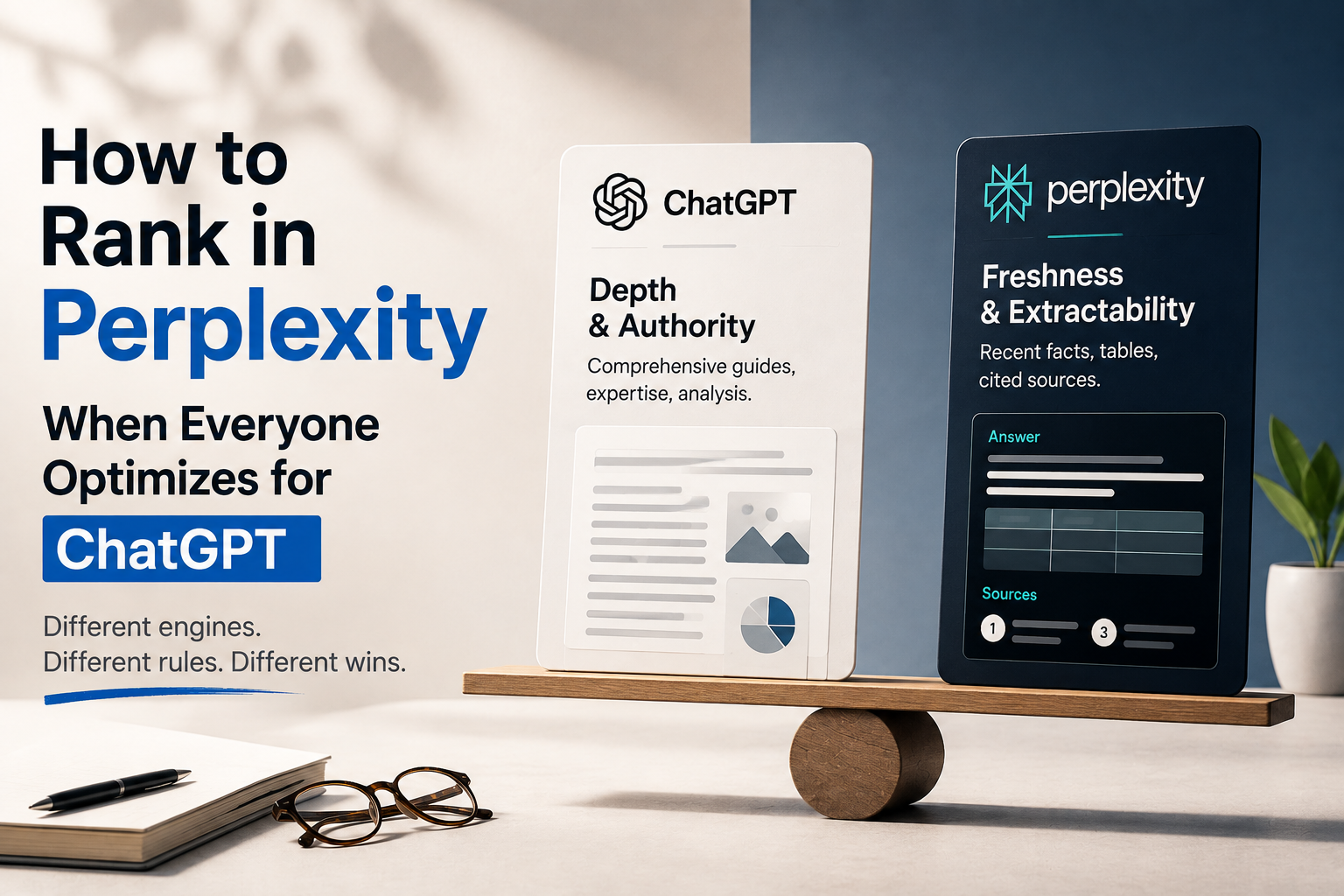
How to Rank in Perplexity When Everyone Optimizes for ChatGPT
Everyone now writes for ChatGPT. With 800M weekly users and 78% of B2B teams competing for AI visibility, the default brief is a comprehensive, authority-led guide. That wins on ChatGPT — and quietly loses on Perplexity, the engine that actually shows its work.
Perplexity is the most explicit citation engine. It surfaces sources inline, and according to SEO-True, domain authority and content freshness are its two most predictive citation factors — not backlink count alone. If your content is built only for ChatGPT's deep reasoning, Perplexity's freshness filter will skip you for a newer, more extractable page.
This is the Perplexity split: same buyer question, different judge.
Why Perplexity and ChatGPT judge differently
ChatGPT favors comprehensive, well-reasoned content with strong expertise signals and original analysis. Perplexity favors recent content on hot topics, answers in <3 paragraphs for simple questions, and credible external sources integrated into the article. ChatGPT may cite you from a 2024 guide if your authority is high. Perplexity will prefer the March 2026 table that answers the same question in 48 words.
Two stats set the frame. BrightEdge 2025: 93% of AI-cited pages carry structured data. Cloudflare 2025: GPTBot crawling jumped 305% YoY. You are being crawled more — but cited only if the page is extractable. SparkToro: clicks to sites fell from ~65% (2023) to 40-45% (2026). The win is no longer the click. It is the citation.
For Rothenhall portfolio companies this matters twice: founders lose pipeline if Perplexity replaces their category search, and funds lose reporting integrity if they measure only Google ranks.
What Perplexity actually wants
From field tests across ChatGPT and Perplexity:
- A 40-60 word direct-answer block immediately after every H2. Not an intro. A self-contained answer Perplexity can lift verbatim. If you screenshot just that block, it should satisfy the query.
- HTML tables, not bullet lists, for any comparison. Surfer SEO 2025: table pages cited 47% more in Perplexity than text-only equivalents. LLMs cut a
<table>row trivially. A**Name: value**list is plaintext to the model. - At least 3 credible external sources + numeric facts with dates. "AI search traffic is growing" gets skipped. "Per Similarweb Q1 2026, Perplexity handles 100M+ queries/month" gets cited. Perplexity cross-checks — a 2024 stat on a 2026 stamp gets dropped at judgment.
- FAQPage + Article schema reflecting visible content only. Not decorative. Perplexity re-weights pages where schema matches the H2 question shape.
- Freshness signal. AirOps 2026: pages not refreshed quarterly are 3x more likely to lose AI citations. Perplexity is the strictest on this — its answer often opens with "As of August 2026..." and prefers sources updated in the last 30-60 days for hot topics.
Google Trends India confirms the shift: ChatGPT SEO holds ~39 interest, Perplexity AI holds ~35, but Perplexity SEO tripled 0→3 in August while ChatGPT SEO flattened. The traffic pool is splitting.
The 5 fixes that move Perplexity without hurting ChatGPT
1. Open every section with the answer, not the context
Bad:
## Perplexity ranking factors
Perplexity is a complex engine that considers many things...
Good:
## Perplexity ranking factors
Perplexity cites pages that answer in a 40-60 word self-contained block, then prove it with a table and 3+ sourced facts. Authority helps, but freshness and extractability decide whether you enter the inline citations.
This block alone is what gets quoted. Detail follows.
2. Convert every comparison to a real table
ChatGPT tolerates prose comparisons. Perplexity extracts tables.
| Engine | What moves citations | Content shape that wins | How to measure |
|---|---|---|---|
| ChatGPT | Authority, comprehensive expertise, named-entity density first 500w | Long guide + About author bio | Citation frequency across 10 prompts |
| Perplexity | Freshness, domain authority, <3 para extractability | 48-word block + table + 3 sources | Inline citations + perplexity.ai referrals |
| Google AI Overviews | Authority + structured data balance | FAQPage + HowTo | AI Overview impressions in GSC |
Render as <table> HTML, not markdown text-as-list. Ensure your SSG outputs clean <table>.
3. Add a sourced number to every claim
Perplexity's judgment stage verifies. One unsourced superlative undermines the whole page. Pattern:
- Cite source with link:
[Stanford AI Lab]or[Similarweb Q1 2026] - Keep numbers visible in HTML, not JS-rendered charts. Perplexity does not run JS.
- Update
datePublishedanddateModifiedvisibly. A stale date is a silent block, not a ranking drop.
4. Ship FAQPage where buyers actually hesitate
Perplexity fields follow-ups instantly: how much, vs, is it worth it. If your page answers only what is, you win the first prompt and lose the next three. Build H2s as question shapes and mirror them in FAQPage:
- What is GEO vs AEO?
- How much does Perplexity visibility cost to fix?
- Perplexity vs ChatGPT: which sends pipeline?
Each FAQ is a second citation surface.
5. Refresh quarterly — treat it as maintenance
AEO decays. Even perfect structure loses citations without upkeep. Operate:
- Month 1-2: ship structure (blocks, tables, schema)
- Month 3: refresh numbers + add 1 new external source
- Monthly: probe 10 prompts in ChatGPT (with search) + Perplexity + Google AI Overviews, log
citation shareper engine
Perplexity rewards the freshest accurate answer in its index. ChatGPT rewards the most authoritative. You need both numbers.
How to know it is working
There is no Search Console for Perplexity. Use three layers:
Ask the engines. 10 buying prompts × 3 engines monthly. Log domain cited, position in inline list, and whether cited inline or as footnote. Perplexity is the clearest to audit — citations are inline.
Track referrals. Perplexity sends measurable perplexity.ai referral traffic; ChatGPT largely does not. In GA4, segment referrals + branded search growth (users cited by AI often search brand later).
Watch decay. If citation share drops 2 months after shipping, it is almost always freshness — not structure. Re-publish with updated table and date.
Rothenhall's Cailyx does this engine-by-engine today: maps how each engine describes you, builds the table-structured citations that move the needle, and tracks share so you see ChatGPT and Perplexity diverge — not blended.
Mistakes that kill Perplexity citations
Writing only for ChatGPT depth. A 3,000-word comprehensive guide without 40-word blocks is unextractable. Perplexity will pick the 400-word competitor with a table.
Leaving old numbers. A page stamped 2026 with a 2024 stat is filtered at judgment. Update or remove.
Lists instead of tables. Six tools as bullets gets ignored. Same six as table with pricing + use case gets cited.
Publishing as JS. If content appears after script, Perplexity sees a blank page. Serve in HTML, render server-side, keep in sitemap.xml and verified in Bing Webmaster Tools (ChatGPT's search partner) + Perplexity's index.
One engine's playbook for all. Copying ChatGPT wins to Perplexity wastes budget. Split the brief: one canonical entity description everywhere (for Claude memory), two content shapes: comprehensive for ChatGPT, chunked+fresh for Perplexity.
For fund platforms: why you must track them separately
A single AI visibility score hides the split. In our pipeline, a portfolio company ranked #2 for citation share on ChatGPT but #11 on Perplexity — same category, same content. The blended score looked fine. The Perplexity audit revealed all cited pages were founder blogs from competitors updated in the last 14 days. Fix was not more authority. It was a freshness cadence owned centrally and applied across 8 portcos via a shared table template — compounding library, not one-off doc.
If you run a Portfolio-wide Retainer, standardize: one table schema, one 40-word block template, one quarterly refresh runbook, one dashboard with ChatGPT and Perplexity as separate lines.
FAQ
Is Perplexity SEO the same as ChatGPT SEO?
No. Perplexity favors freshness and explicit inline citations; ChatGPT favors comprehensive expertise and authority. Both use the same foundations — 40-60 word blocks, FAQPage, entity consistency — but weight them differently.
How long does Perplexity take to cite new content?
Days for hot topics, 2-4 weeks for structural fixes to reindex. High-authority domains see faster pickup. Consistency compounds: publishing the second page in a cluster lifts the first.
Do tables really help Perplexity rankings?
Yes. Surfer SEO 2025: table pages cited 47% more in Perplexity than text-only equivalents. Format specs, comparisons and pricing as <table>, not lists.
How do I measure if I rank in Perplexity?
Probe 10 prompts monthly across Perplexity + ChatGPT + Google AI Overviews, log citation share, and track perplexity.ai referrals + branded search. Tools like Cailyx automate this.
Rothenhall Partners is the fractional operating partner for AI-era growth — AEO/GEO, GTM and RevOps owned as one engine. Cailyx maps engine-by-engine citation share so you see where you are named, and what to ship next. Request a diagnostic — we will show you ChatGPT vs Perplexity side-by-side for your category.