
What Is AEO? Answer Engine Optimization Explained (2026)
Answer engine optimization (AEO) makes your content the answer AI engines quote — not just a page that ranks. The definition, the AEO vs SEO vs GEO split, the eight tactics that earn citations in ChatGPT, Perplexity, and Google AI Overviews, and how to measure citations.
By Kunal Achintya Reddy · 10 min read · 2 September 2026
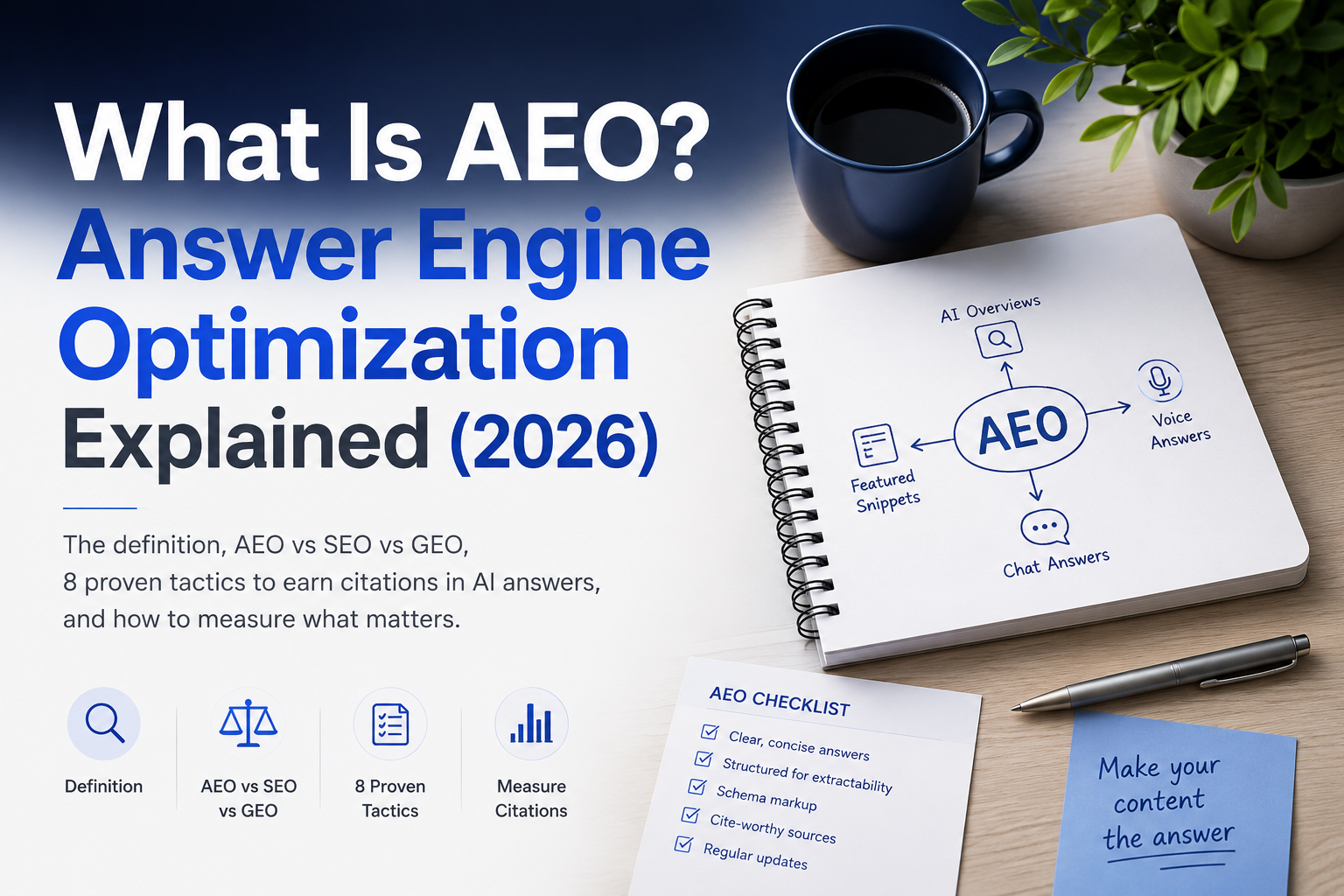
What Is AEO? Answer Engine Optimization Explained (2026)
Answer engine optimization (AEO) is the practice of structuring your content so AI engines — ChatGPT, Perplexity, Google AI Overviews, and voice assistants — can lift it directly as the answer. Instead of ranking a page that gets clicked, AEO makes your page the source an AI quotes, cites, or recommends.
Search didn't get smaller. It stopped clicking. ChatGPT passed 900 million weekly active users in February 2026, Gartner projects traditional search volume will fall 25% by 2026, and SparkToro's search behavior study found 58.5% of US Google searches end without a click. Your next customer increasingly meets your brand as a sentence inside an AI answer — not as a blue link. AEO is how you win the sentence.
Key takeaways
- AEO = making your content the answer, not just a source that ranks. The unit of success shifts from position #1 to citation inside the AI response.
- The three siblings: AEO targets answer surfaces (AI Overviews, snippets, voice), GEO targets generative engines (ChatGPT, Perplexity), and SEO still feeds both — AI engines overwhelmingly cite pages that also rank in classic search, yet 89% of AI citations come from outside the top 10 results.
- Extractability beats raw authority on this keyword. One-person sites rank beside Shopify and Coursera for "what is AEO" because their definitions are clean, quotable, and dated.
- The playbook is a repeatable structure: a 40–60 word answer block under each heading, comparisons as tables,
FAQPageschema, and a refresh cadence measured in weeks. - Measure differently: count citations and share-of-answer inside AI responses — not just rank and sessions.
What is answer engine optimization (AEO)?
Answer engine optimization is the discipline of getting your content selected as the response to a question — in Google AI Overviews, featured snippets, voice assistants like Siri and Alexa, and chatbots like ChatGPT and Perplexity. Where traditional SEO optimizes a page to rank, AEO optimizes it to be cited: a self-contained answer an engine can lift verbatim and attribute.
The mechanics are closer to being quoted by a journalist than to winning a race. An answer engine scans its corpus for content that is (a) directly responsive to the question, (b) factually consistent with its other sources, and (c) easy to extract without surrounding context. Pages optimized for SEO usually satisfy (a). Most fail (c) — the answer is buried in paragraph six, hedged by ten qualifiers, or locked inside an image.
AEO full form (and the alphabet soup around it)
The acronym expansions you'll encounter, in one place — because a large share of searches for AEO are people decoding the acronym:
| Term | Full form | What it means |
|---|---|---|
| AEO | Answer Engine Optimization | Optimize content to be selected as the answer in AI Overviews, snippets, and voice results. |
| GEO | Generative Engine Optimization | Optimize content to be cited inside generated answers from ChatGPT, Perplexity, Gemini, Copilot. |
| AIO | AI Optimization | The emerging umbrella term some vendors use for AEO + GEO together. |
| SEO | Search Engine Optimization | Optimize pages to rank on traditional search engine results pages. |
| LLM SEO / AI SEO | — | Informal names for the same generative-targeting practice, used interchangeably in most 2026 content. |
In most current usage AEO and GEO describe overlapping work. Cut the distinction carefully: AEO leans toward direct answers (the user asks a question, one answer appears), GEO leans toward presence in generated text (the model composes an answer and mentions you among its sources). Practically, the content changes are the same set.
A note on an unfortunate ambiguity:
GEO in SEOis often searched by people asking about geographic targeting — local SEO, geo-modified keywords, service-area pages. That's an unrelated 2010s meaning of the term. If you arrived here asking about local targeting, GEO as used in this article is Generative Engine Optimization — a different discipline entirely.
How answer engines choose what to cite
No engine publishes its formula, but a 2026 meta-analysis of 54 citation studies (Zyppy) puts URL accessibility and search rank among the strongest evidence-backed factors — engines cite pages they can reach, that already rank, and whose answers match the query. Beyond those, five patterns hold:
- Extractability. The answer appears early, in short declarative sentences, without needing the rest of the page. BrightEdge reports sites that added structured data and FAQ blocks saw roughly 44% more AI citations.
- Consensus. Answer engines are tuned to avoid hallucination, so they favor claims corroborated across sources. BrightEdge's research puts ~89% of AI citations outside the top 10 organic results — the corpus, not the ranking, decides.
- Freshness. Pages refreshed in the last 30–90 days materially out-cite stale equivalents on fast-moving topics; Perplexity often prefaces answers with "as of August 2026…" because it wants sources it can date.
- Entity and brand salience. ChatGPT recommendations lean on mentions across third-party surfaces it has read: review sites, Reddit threads, comparison articles, press.
- Structural depth. A Search Engine Land analysis of 8,000 AI citations found 82.5% of AI Overview citations point to deep content pages — not homepages. The easier the page is to parse section by section, the higher the odds of citation.
AEO vs SEO vs GEO
All three are visibility disciplines; they differ in the surface optimized for and the unit of success.
| SEO | AEO | GEO | |
|---|---|---|---|
| Optimizes for | Search engines (Google, Bing) | Answer surfaces (AI Overviews, snippets, voice) | Generative engines (ChatGPT, Perplexity, Copilot) |
| Winning outcome | Rank #1, click-through | Quoted as the direct answer | Mentioned and cited inside the generated response |
| Content unit | Full page targeting a keyword | Self-contained answer block (40–60 words) | Extractable passage + external corroboration |
| Key signals | Backlinks, topical authority, page experience | Question-shaped headers, schema, freshness | Brand mentions, consensus with corpus, citations |
| Measurement | Rank positions, organic sessions | Snippet/AI Overview presence, citation share | Prompt tracking, share-of-answer, branded search lift |
A fuller comparison — with traffic-window analysis and where the overlap hurts — belongs in its own dedicated breakdown of SEO vs AEO vs GEO.
One uncomfortable truth sits under the table: the click is disappearing. Of every 1,000 US Google searches in SparkToro's 2024 study, only 360 went to the open web — and BrightEdge found 93% of Google AI Mode searches end without a click to any website. AEO's honest pitch is not "more traffic" — it's presence at the moment of the answer, which behaves like advertising: brand exposure at the decision point even when the session never touches your domain.
Why AEO matters
- The volume is shifting now. Gartner's forecast (February 2024): traditional search volume drops 25% by 2026 as users move to AI assistants.
- ChatGPT is mainstream. 900M weekly active users as of February 2026 (OpenAI, via Search Engine Land) — asking a daily mix of product, comparison, and how-to questions. Perplexity alone processed 780 million queries in May 2025 and has kept growing since.
- The citation market is contestable. With 89% of AI citations coming from outside the top 10 organic results, a small site with clean, dated, extractable content out-cites larger pages that bury their answers.
- SEO still feeds AI. The meta-analysis signal cuts both ways: pages that rank in classic search dominate the citation pool. AEO is not a replacement for SEO — it is SEO's newest payout surface. Ignore the basics and no AEO tactic rescues you.
How to do AEO: 8 tactics that move citations
1. Answer first, context later
Open every section with a 40–60 word self-contained answer, then elaborate. If a user's question and your first sentence were screenshotted together, the screenshot should satisfy the query.
2. Make headings the questions people actually type
"Can AEO work without a big budget?" — not "Budget considerations." Question-shaped headings match how engines segment intent and how People Also Ask cascades.
3. Use tables for every comparison, lists for every process
A <table> row is the most extractable unit on the internet; a model can cut one cleanly. The same comparison as a bullet list is plaintext soup to a parser.
4. Date your content — visibly
Publish date and last-updated on the page, not just in the sitemap. Refresh quarterly minimum on fast-moving topics; freshness is among the strongest predictors of citation.
5. Build the FAQ section for people and parsers at once
Genuine questions — phrased from People Also Ask, Reddit, and chatbot transcripts — with concise prose answers, then matching FAQPage schema. Schema must mirror visible content; engines discount markup that describes content that isn't there.
6. Cite sources and state numbers
"AI search is growing" is invisible. "Perplexity processed 780 million queries in May 2025 (TechCrunch)" is citable. External references establish consensus and give the engine a corroboration path to your page.
7. Make the entity match the question
Answer engines resolve entities, not just strings. Consistent naming — company, author, credentials — across your site, LinkedIn, and directories lets the model attach your citations to one confident entity.
8. Widen the corpus you appear in
ChatGPT recommendations draw on what the model has read about you elsewhere: review platforms, comparison articles, Reddit, YouTube. The brands cited most are the ones described clearly and favorably on the surfaces models read by default.
How to measure AEO
- Citation presence — for 20–50 prioritized prompts, check weekly whether your brand or URL appears in ChatGPT, Perplexity, and Google AI Overviews responses. Manual sampling is fine at this scale.
- Share of answer — when five competitors are cited and you are not, count it. Your slice of mentions against the competitive set is the real metric.
- Referral and branded search lift — Perplexity passes a referrer header, so visits show in GA4 as
perplexity.ai / referralunder Traffic acquisition (caveat: copy-paste visits land as Direct). Citations typically drive branded searches weeks later. - Crawler visibility — AI crawlers are now a normal part of server logs; Cloudflare measured GPTBot request growth at 305% year over year (May 2024→May 2025). If GPTBot never fetches your new content, it cannot cite you.
Common AEO mistakes
- Burying the answer. The definition on line 9 gets skipped; a new site with it on line 1 out-cites you.
- Decorative schema. FAQPage markup covering questions absent from the visible page gets discounted.
- Judging by referrals alone. AEO's value is unattributed brand demand; optimizing an answer page on sessions will conclude it failed.
- Splitting AEO and GEO into separate projects. The content work is the same set; you just double the briefs.
- Trusting opaque visibility scores. Most "AI visibility" numbers are vendor composites — track prompt-level citations you can verify yourself.
FAQ
What is AEO and GEO together? AEO targets answer surfaces — Google AI Overviews, featured snippets, voice assistants — where a direct answer is selected from sources. GEO targets generative engines — ChatGPT, Perplexity, Copilot — where the model composes its own response and may cite your content. The overlap is large enough that most teams run one combined practice.
Is AEO replacing SEO? No. AI engines draw citations mostly from pages that already rank in classic search — search rank is among the strongest citation factors measured. AEO is a formatting and distribution layer on top of SEO: crawlability and authority still decide whether you're in the pool.
Is AEO certification worth it, or do you need a course? No industry-recognized AEO certification exists; vendors (HubSpot, Semrush and Ahrefs academies, Surfer) sell short AI-search courses that are useful primers, not credentials. Practitioners learn fastest by auditing which prompts cite them and iterating on the pages that almost got cited.
What's an example of AEO vs GEO? AEO: a user asks Google "what is AEO" and the AI Overview quotes your definition paragraph verbatim with a citation link. GEO: a user asks ChatGPT "what tools help agencies track AI search visibility?" and the model lists your product among five from memory. One is selection-from-source; the other is description-from-memory.
Do small sites have a chance at ranking in AI answers? Yes — more than in classic Google results. BrightEdge's data shows ~89% of AI citations come from outside the top 10 organic results, and 82.5% of AI Overview citations go to deep content pages, not homepages. Authority matters; formatting correctness matters first.
Sources
- OpenAI via Search Engine Land, Feb 27 2026 — ChatGPT passes 900M weekly active users.
- Gartner press release, Feb 19 2024 — "Search Engine Volume Will Drop 25% by 2026."
- SparkToro / Datos, 2024 Zero-Click Search Study — 58.5% of US, 59.7% of EU searches end without a click; 360 open-web clicks per 1,000 US searches.
- BrightEdge AI research — 93% of Google AI Mode searches end without a click; ~89% of AI citations from outside the top 10; ~44% citation lift from structured data + FAQ blocks.
- Zyppy (Cyrus Shepard), May 2026 — meta-analysis of 54 AI citation studies; URL accessibility and search rank strongest.
- Cloudflare blog, 2025 — GPTBot raw requests +305% YoY (May 2024→May 2025).
- TechCrunch, June 2025 — Perplexity processed 780M queries in May 2025.